

The Paradigm Shift: Redefining Climate and Rain
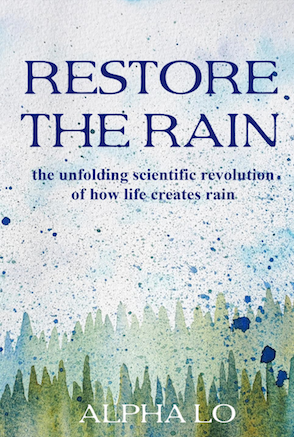
Alpha Lo’s engaging and informative book, Restoring the Rain, offers a much-needed perspective of the global water emergency. The core thesis explores an emerging scientific understanding: life on land, including trees, soil, and microbes, actively creates and influences rainfall, rather than just reacting to it. Historically, traditional climate models have viewed climate as unidirectional. However, significant scientific breakthroughs in rain research, isotope analysis, and advanced Earth System Models reveal complex, bidirectional climate-vegetation interactions. By demonstrating how land degradation and deforestation disrupt local precipitation recycling, the book effectively challenges the old paradigm and highlights the critical ecological and climate implications of land-atmosphere feedbacks.
Lo says, “’The new paradigm points to new ways of water management by restoring forests, grasslands, wetlands, and aquifers as a way of increasing rain and water supply. The revolutionary insight is that we can partner with life to make more rain.”
The Science: Feedback Loops, Biotic Pumps, and Bioaerosols
To ground this paradigm shift, the narrative dives into the fascinating biological mechanisms regulating Earth’s water cycles. It connects modern research to foundational ecological theories, such as Lovelock and Margulis’s Gaia hypothesis, showing how the Earth’s biosphere self-regulates through complex feedback loops. The book highlights theories like the CLAW hypothesis in marine biology and Gorshkov and Makarieva’s “biotic pump” theory, which proposes that intact forests act as planetary water pumps to actively transport atmospheric moisture and even suppress hurricanes.
On a microscopic scale, the text illustrates how bioaerosols function like planetary hormones. Microorganisms such as the bacteria Pseudomonas syringae, fungal spores, and organic terpenes emitted by trees act as highly efficient cloud condensation nuclei, seeding rain and influencing ice formation at higher temperatures. When these systems are disrupted by rising CO₂ levels, it triggers an amplifying water vapor feedback loop that severely accelerates planetary warming and lengthens dry seasons.
The Solutions: Rebuilding the Planetary Sponge
Ultimately, Restoring the Rain is a call to action that champions nature-based solutions and bottom-up initiatives to reverse land degradation. The book illustrates how restoring soil health through organic practices and permaculture creates a “soil carbon sponge” that drastically improves water retention, cools landscapes, and mitigates the dual threats of drought and flooding. Real-world success stories, like farmer Gabe Brown’s regenerative agriculture practices, demonstrate that soil regeneration actively reduces drought vulnerability while boosting crop yields.
The book seamlessly bridges indigenous wisdom with modern hydrological science, highlighting traditional techniques like zai pits, terracing, silvopasture, and modern “sponge cities” that slow, sink, and spread water. From Farmer Managed Natural Regeneration (FMNR) using tree stumps to revive drylands, to community-led water-harvesting infrastructure, the text proves that even small-scale restoration can positively influence local and regional rainfall. Restoring the Rain delivers a vital, hopeful message: by combining global practitioner training with international cooperation, we can heal our landscapes, restore the planetary water cycle, and secure a sustainable future for life on Earth.
Lo writes, “’This is a story about restoring water cycles, on the land, in our aquifers, and ultimately in the air itself through the small water cycle, or precipitation recycling. The 20th century was built on a paradigm of controlling nature’s water cycles, manipulating rivers with dams and reservoirs, moving water vast distances through aqueducts. But a new paradigm is emerging: instead of fighting water cycles, we work with them.”