

Nainital lake’s lifeline under threat with plans to choke most important recharge zone – Sukhatal.
SUKHATAL TOURISM PROJECT: DISASTER IN THE MAKING
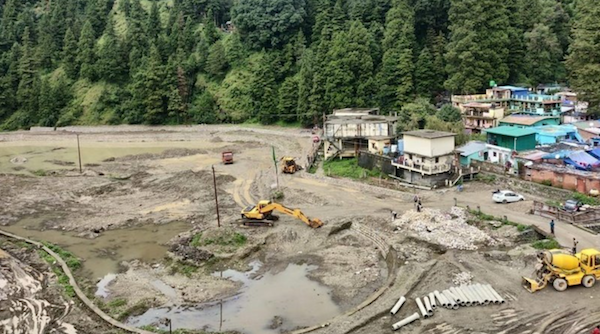
Sukhatal is a seasonal lake located about 800 meters from the Nainital Lake, and is its most important recharge zone. The authorities plan to develop it into a tourist spot, which will choke Sukhatal’s lakebed.
HELP, NAINITAL LAKE IS DRYING UP!
The water balance (inflow and outflow) of the Nainital lake depends upon several factors, like direct precipitation, surface flows, subsurface flows, evaporation, and release of water through sluice gates. However, rapid and unplanned development, along with changing climatic conditions, have resulted in unprecedented deterioration of this lake. Today, the lakeupon which the economy of the town thrives is in danger of drying up!
The most important factor of the deterioration is the ill-treatment of the recharge zone of Nainital Lake – Sukhatal. As a result, there has been a drastic decline of water in the Nainital Lake, a phenomenon rarely observed in the 20th century, which has now become quite frequent.
Between 2002 and 2016, the lake reached zero level (the minimum level of water to be maintained) 10 times. In 2016, the zero-level mark was touched in the month of February, whilst in 2017 it was as early as January.
Despite this, the State government and local administration’s misguided priorities have largely been on improving the attractiveness of the Nainital Lake and its immediate surroundings, including Sukhatal, at the expense of its health. There has been very little effort to understand how water moves under the ground to recharge the Nainital lake.
SUKHATAL’S IMPORTANCE TO NAINITAL LAKE
- Sukhatal is a seasonal lake that falls under the category of a wetland, as per the established guidelines of the Ministry of Environment, Forest and Climate Change. Sukhatal is well underwater for approximately 4 months during a normal monsoon year.
- Studies conducted by the National Institute of Hydrology (NIH), Roorkee, the Indian Institute of Technology, Roorkee (IIT-R), and the Centre for Ecology Development and Research (CEDAR), Dehradun, indicate that Sukhatal provides 40-50% subsurface water to the Nainital Lake.
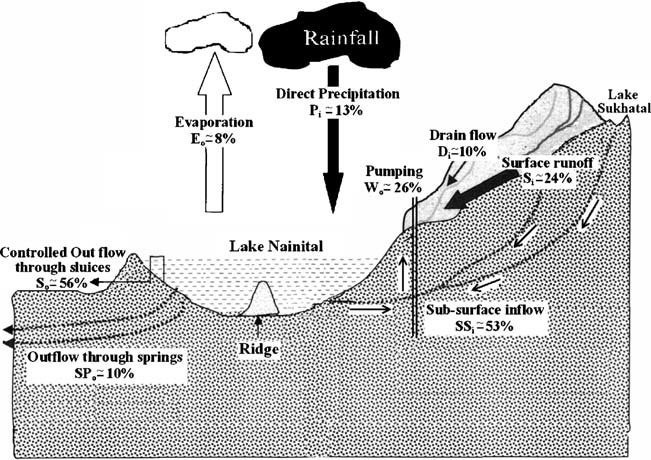
HOW THE NAINITAL LAKE GETS RECHARGED
- Existing constructions in Sukhatal by the State government, local administration, and influential individuals, such as car parking built by KMVN, the ADB building, the dumping of construction debris, and illegal construction of private homes in this area, has significantly reduced the volume and infiltration capacity of the Sukhatal Lake.
- Unregulated and unauthorized construction on the Sukhatal lakebed has changed the natural flow of water from the Sukhatal Lake towards the Nainital Lake. Under normal conditions, this water would have seeped over time through the ground, slowly reaching the Nainital Lake and maintaining its water level. The construction debris dumped over the Sukhatal lakebed has created an impervious layer that now obstructs the natural infiltration and subsurface flow of water, resulting in extreme fluctuation of water into the Nainital Lake.
- The Nainital lake receives water from many sources, such as drains, subsurface flows, natural springs, etc. However, the government is knowingly tampering with these recharge zones, despite scientific evidence on the importance of Sukhatal for the preservation of the Nainital Lake.
PROBABLE IMPACTS OF SUKHATAL TOURISM PROJECT
- Decrease in Nainital Lake’s water level.
- The topography of Sukhatal is characterised by karst features owing to the presence of limestone and dolomite. The features are relatively fragile; hence the sheer weight of the water may lead to the collapse of the Sukhatal reservoir resulting in colossal damage to the Nainital town.
- Nainital is an earthquake-prone area and falls under zone IV (severe intensity zone) of the Earthquake Zoning Map of India. The active Nainital fault bisects the Nainital lake into two halves and runs parallel to Sukhatal. Creating a reservoir of Sukhatal, and storing a huge quantity of water near the fault will be a monumental mistake, as any tectonic activity may damage the reservoir, resulting in a flood-related disaster.
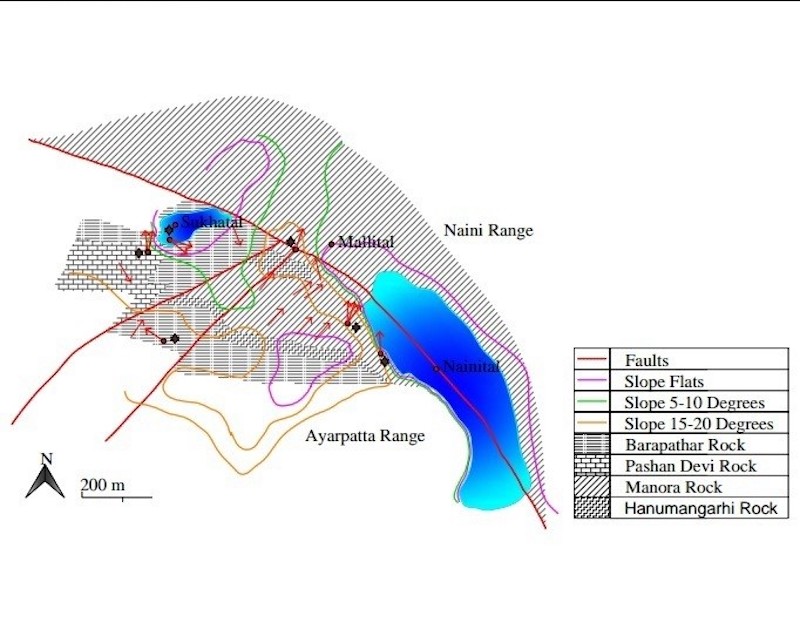
- Sukhatal has its own significance with bore wells installed that provide 2 MLD (million liters per day) of water to the town. This indicates that an unconfined aquifer exists below the lakebed which is naturally replenished by water seeping through the ground. Sealing the lakebed would gradually deplete this aquifer.
- The proposal to make an artificial water body on the Sukhatal lakebed is largely driven by the idea that this project would help boost tourism. However, this project will only hurt people and ultimately collapse the tourism industry, since converting Sukhatal into a second tourist spot will impair Nainital Lake’s hydrological balance, and will expedite the lake drying up.
- On average, Nainital Lake provides water to a minimum of 60,000 people daily (including its tourist population). However, the increasing tourist population in Nainital has become unsustainable, considering the town’s limited resources. Developing Sukhatal as yet another tourist spot in the town will be detrimental to the tourism industry in the long run, since it will further increase the tourist footfall, increasing the pressure on the town’s resources. Hence, instead of over-exploiting Nainital’s resources, the need is to create new tourist destinations in Uttarakhand so tourism can be decentralized and sustainable.
HOW YOU CAN HELP
Help Save Sukhatal by signing this petition
MEDIA LINKS
- Naini lake is depleting, but can we undo the wrongs? ~Sushmita Sengupta, Ishan Kukreti, Sunita Narain in Down to Earth
- Watch & Read ~ Noman Siddiqui in The Quint
- Revive Sukhatal for Naini lake survival, suggest experts ~ Vineet Upadhyay in TOI
- In giving life to Nainital, its lifeline is dying ~ Neeraj Santoshi In Hindusthan Times
- नैनी झील के महत्वपूर्ण जलागम को ख़तरा ~ Kavita Upadhyaya in Carbon Copy (Hindi)